


By Serkant Uluderya, Netsia
The Broadband Forum (BBF) is currently developing WT-525 Virtual OLT Hardware Abstraction Alignment with CloudCO to align open standards with open source software. This project brings together “working code” from de facto software solutions and the “hardened requirements” used by service providers for procurement and compliance.
What is WT-525?
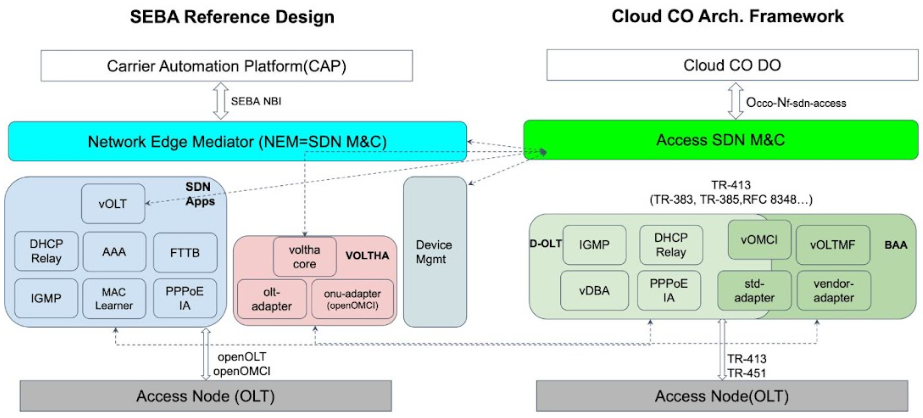
WT-525 is a “Working Text” titled “Virtual OLT Hardware Abstraction Alignment with Cloud-CO”. It provides a technical mapping between the CloudCO Issue 1.0 architectural framework and the SEBA (Software Defined Broadband Access) Reference Design 2.0. In addition, it incorporates the consolidated requirements and interfaces into one document, which will be published as a Broadband Forum Technical Report. While these two frameworks share similar goals, they have historically used different software and deployment terms. WT-525 creates a formal foundation to bridge these architectural differences based on joint analysis by BBF and LF Broadband experts.
The Alignment Approach
The mapping focuses on three primary areas to ensure end-to-end interoperability:
- Northbound API (NBI): This aligns the interface between OSS/Orchestration engines and the SDN layer. Specifically, the SEBA NBI is mapped to the CloudCO Occo-Nf-sdn-access interface.
- SDN Management and Control (SDN M&C): This maps individual software components, such as the SEBA Network Edge Mediator (NEM), to the equivalent Access SDN M&C blocks in the CloudCO architecture.
- Southbound API (SBI): While the functional parity between VOLTHA (Virtual OLT Hardware Abstraction) and BBF TR-477’s D-OLT (Disaggregated OLT) is high, the working text defines the protocol mapping. BBF specifications standardize the use of Minf and Mfc interfaces (NETCONF) towards the physical OLT, while VOLTHA uses the OpenOLT gRPC API, and both share the use of YANG for data modelling.
Why This Matters for Operators
The primary value of WT-525 is providing a standardized path for operators to adopt a wider choice of solutions and, importantly, open source innovation without sacrificing carrier-grade stability and also adds the ability to choose whitebox hardware solutions in addition to black and grey box of their choosing:
- Procurement Readiness: Operators can now add open source solutions like SEBA and VOLTHA to their procurement and deployments with confidence that they align with the hardened BBF standards required in their procurement processes.
- A Critical Step for Disaggregation: By aligning open source software (VOLTHA) with standard architectures, WT-525 is a key enabler for network disaggregation, allowing operators to move away from vendor-locked vertical stacks.
- Faster Integration: Aligning open source with standards significantly reduces the time needed to integrate new suppliers into an operator’s ecosystem. Instead of the traditional integration cycle, this harmonized approach makes adding new software providers a much easier task.
By anchoring open source code to established standards, WT-525 ensures that the industry can innovate quickly while maintaining the interoperability that global broadband networks require.
We invite the industry – both operators and vendors – to join us in this effort. Having more stakeholders involved and sharing their challenges, needs, ideas, and contributions will both speed this alignment and make it more effective. To get involved in the LF Broadband effort, contact the VOLTHA Technical Steering Team at https://lists.voltha.org/g/Discuss. Those interested in contributing to the Broadband Forum’s efforts on this project who are not already a member can contact Rhonda Heier, (Director of Membership Development) at rheier@broadband-forum.org.
